
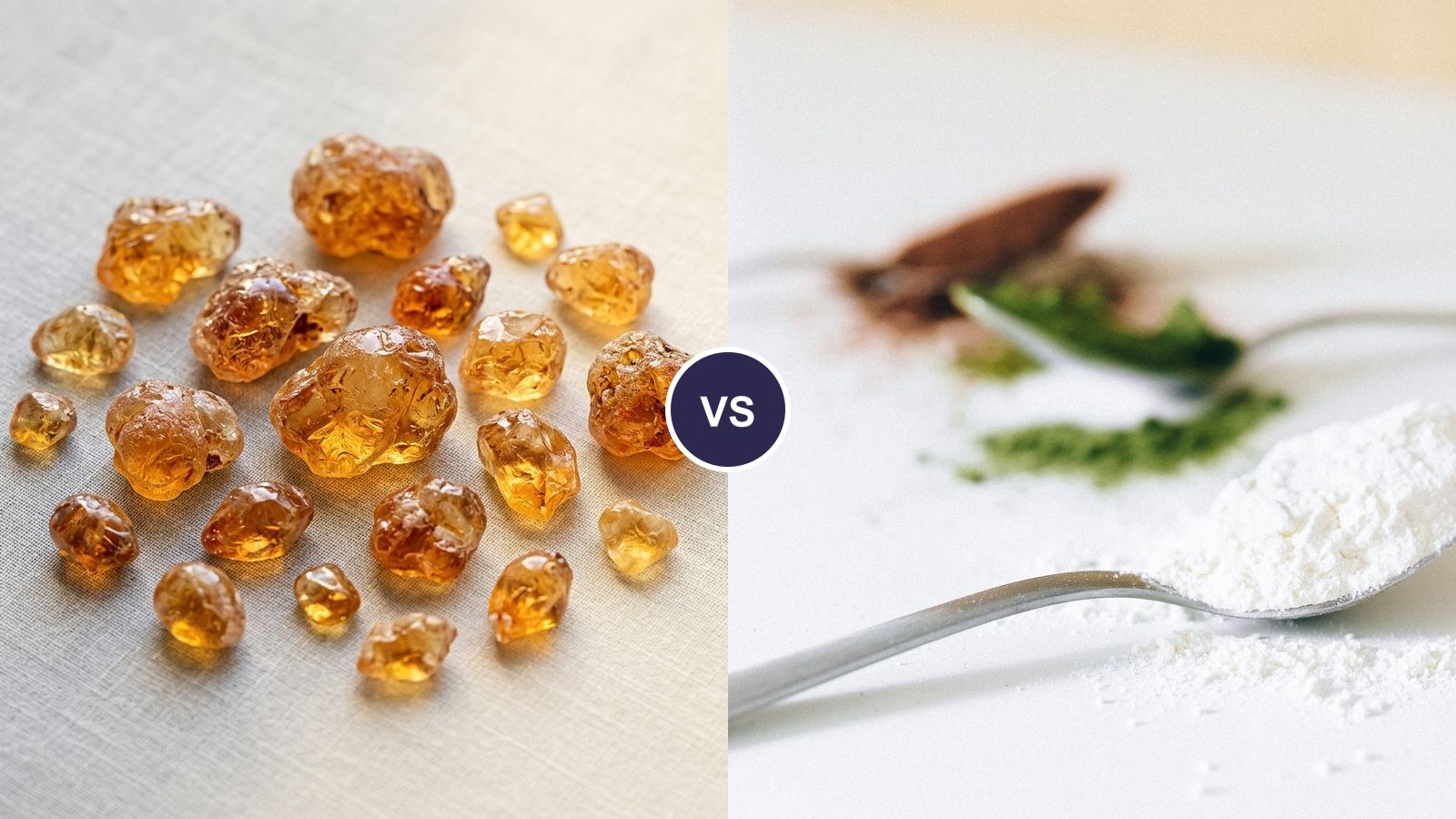
Arabic gum and psyllium husk are both soluble fibres, but they behave differently in the gut — Arabic gum dissolves clear and ferments slowly, while psyllium husk swells into a thick gel and bulks stool more aggressively. Neither is universally "better" — the right choice depends on what you actually need it for.
What's the difference between Arabic gum and psyllium husk?
Both are classified as soluble dietary fibres, but their source, texture, and effect on the gut are quite different — see Wikipedia's overview of gum arabic and Wikipedia's overview of psyllium for each ingredient's background.
How each dissolves and feels in a drink
Arabic gum dissolves fully into a clear liquid with no noticeable texture change, which is why it mixes cleanly into water, juice, or tea. Psyllium husk instead absorbs water and swells into a thick, mucilaginous gel — it doesn't dissolve clear, and needs to be drunk fairly quickly before it thickens too much.
How each behaves in the gut
Fermentation speed
Arabic gum ferments slowly in the gut, which is one reason it's generally considered gentler and less likely to cause sudden gas or bloating. Psyllium ferments less than some fibres too, but its physical bulking effect is much more pronounced.
Bulking effect
Psyllium husk is well known for its strong bulking action — it significantly increases stool volume and softness, which is why it's a common recommendation specifically for constipation. Arabic gum has a much milder bulking effect and is used more for general prebiotic and digestive support.
Arabic gum vs psyllium husk: quick comparison
- Texture: Arabic gum dissolves clear; psyllium husk swells into a gel.
- Gentleness: Arabic gum is generally milder for beginners; psyllium is more intense.
- Best for: Arabic gum suits everyday gut and prebiotic support; psyllium is more often used specifically for constipation relief.
- Taste and mixing: Arabic gum is neutral-tasting and mixes into any drink; psyllium's texture is more noticeable and some find it harder to drink quickly.
Try the Gentler Option First
Halal-friendly Arabic Gum Powder in 5 flavours — an easy starting point for new fibre users.
Which is gentler for beginners?
Arabic gum is generally the gentler starting point. Its slower fermentation and milder bulking action make it less likely to cause the sudden bloating some people experience when starting psyllium husk at a full dose. See our side-effects and safety guide for how to introduce any new fibre gradually.
Can you take both together?
Some people do use both, but it's best to introduce them one at a time and at a low dose each, so you can tell which one is responsible if you notice any digestive discomfort. Combining two strong fibres at full dose from day one is more likely to cause bloating than either alone.
Buying tips for whichever you choose
If you decide Arabic gum is the better fit, the same buying basics apply as any Sihatree product: confirm it's Halal-friendly, buy through a Halal-focused provider, and check our buying guide for retail and wholesale channels across Malaysia.
Psyllium bulks harder and faster; Arabic gum works more gently over time — the "better" one depends entirely on what your gut actually needs.


